Smart Lighting Schedules That Make an Empty House Look Occupied
Most home security lighting fails for a boring reason: it is too regular. The same lamp, the same minute, the same three rooms, every night of the year. Anyone with a view of the front of the house can learn that pattern in a few evenings, and a pattern is exactly what makes a home look empty. The good news is that fixing this doesn't require expensive equipment or a complicated setup. It requires a schedule that behaves like a household.
The Problem With One Lamp on a Timer
A plug-in timer in the living room is better than a dark house, but only just. It produces a single switch-on, a single switch-off, and a long stretch of nothing in between. Real homes don't look like that. Someone gets up for a glass of water at eleven. The bathroom light goes on for four minutes and then off. The kitchen glows briefly at seven in the morning, then goes dark while everyone is out.
Those small, irregular events are what people actually notice from the street. A house that shows a few of them looks lived in. A house that shows one lamp, on the dot, for five hours, looks like a house with a timer in it.
So the goal is not to keep more lights on for longer. The goal is to make fewer lights behave in a way that matches how people move through a home.
Start With the Rhythm You Actually Live
Before touching an app, spend one ordinary evening paying attention to your own habits. Which light do you switch on first when you get home? Where do you go next? When does the kitchen stop being used? Most people discover they use four or five lights on a normal weeknight, not twelve, and that the sequence is surprisingly consistent.
Pick two or three anchors
Anchors are the moments that stay roughly fixed no matter what: the hallway light when you get in from work, the kitchen between six and eight, the bedside lamp before sleep. Set these close to your real times, and let everything else drift around them.
Then tie the evening to sunset rather than to the clock. In December the lights should come on shortly after four; in June, closer to nine. A schedule built on fixed clock times will be two hours out of step with the sky for half the year, which is one of the clearest tells there is. Most smart lighting apps let you set a schedule relative to sunrise or sunset, so use that setting even if you never touch anything else.
Randomize Like a Person, Not a Random Number Generator
Randomization is where well-meant setups go wrong. A schedule that changes every light at unpredictable seconds looks artificial in a different way, because nothing in a real home changes all at once. The aim is natural variation, not chaos.
- Use wide windows, not tiny ones. A light that comes on somewhere between 18:40 and 19:25 is convincing. A light that comes on at 18:52 plus or minus ninety seconds is still a fixed time.
- Randomize duration as well as start. Some evenings the living room stays lit until eleven; others, it's dark by nine-thirty.
- Keep two anchors solid. If absolutely everything shifts, the house starts to look erratic. Let the hallway and the bedroom stay predictable and vary the rest.
- Limit how many rooms are lit at once. Two or three is normal. Six is a film set.
- Let a room skip a night. A schedule where every lamp fires every evening is as regular as a timer. Build in a small chance that a given light simply doesn't come on.
If your app supports scenes or routines, build one for weekday evenings, one for weekends and one for short trips. Weekends start later and run later. That difference alone is worth more than any amount of extra brightness.
Layers, Rooms and the Right Kind of Light
Think in layers rather than in individual bulbs. The entry and hallway come first, because that is the light a visitor or a passer-by sees through the front window. Then the room where someone would plausibly sit: living room, or kitchen if it opens onto the street. Bedroom lights come last and stay on briefly.
Warm white is the safer choice for the rooms visible from outside. Cool, bright light reads as a security floodlight, not as someone reading on the sofa. If you have dimmable bulbs, run them at part brightness in the evening and let the brightness fall as the night goes on. It looks like a household winding down, and it costs less to run.
A television glow is a nice touch if you already have a way to create one, but don't overbuild. Two or three well-chosen lights, moving at believable times, beat a house full of effects.
Setting Up an Away Routine: A Step-by-Step
- Walk the house at your usual evening hour with a notebook or your phone, and write down every light you switch on, in order. This is your raw material.
- Group bulbs into rooms in the app rather than by fixture. You want "kitchen", not "ceiling bulb 3".
- Set the anchors — hallway, kitchen, bedroom — using a sunset offset for the first, fixed times for the rest.
- Add a randomization window of twenty to forty minutes to the start of each non-anchor light, and a similar variation to how long it stays on.
- Build a shutdown sequence so the house goes dark gradually rather than all at once: living room off, then hallway, then bedroom a little later.
- Live with it for a week before you trust it. Run the schedule while you're at home and watch whether it feels plausible. Adjust the windows, not the whole plan.
One practical detail: keep at least one lamp on a simple plug-in timer as a fallback, in case the Wi-Fi drops or the hub needs a restart while you're away. A schedule that depends on a single point of failure isn't much of a schedule.
Mistakes That Give the Game Away
- Every light coming on and going off at the same moment.
- A bathroom light burning steadily from two in the afternoon until midnight.
- Bright white light in a living room with the curtains open.
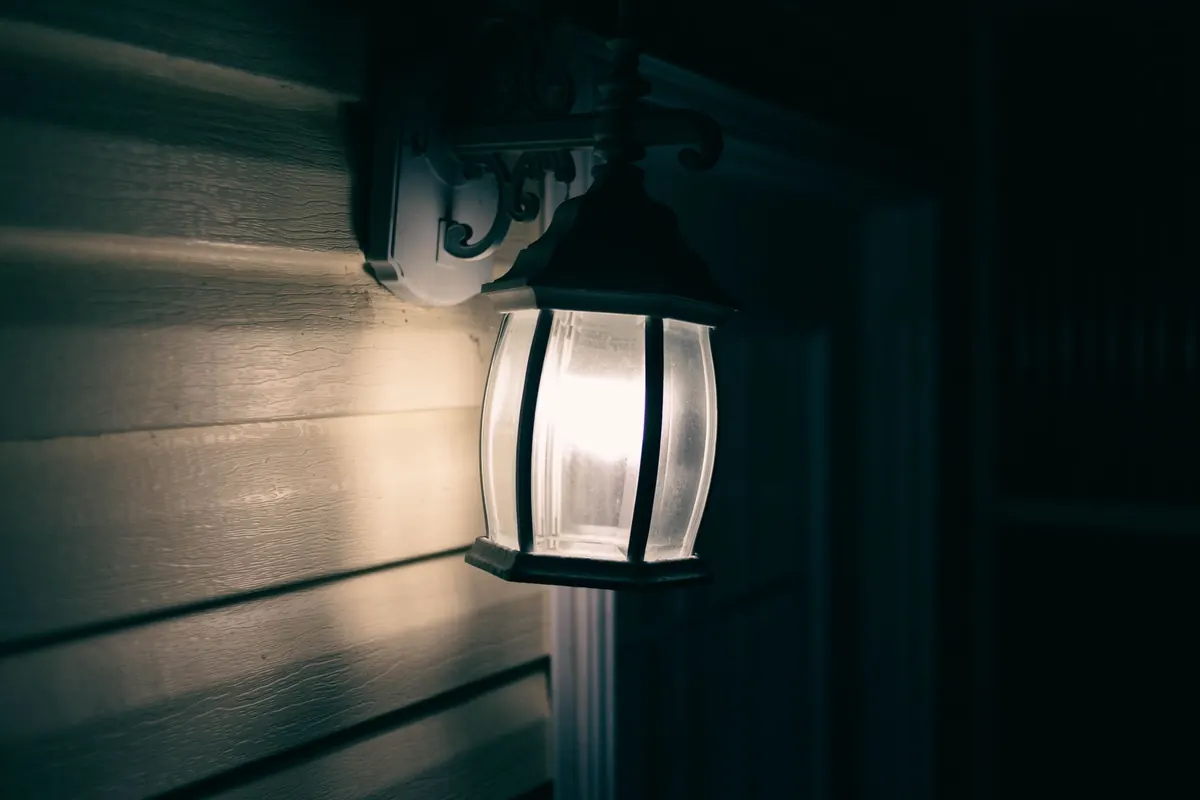
- Outdoor lights blazing all night, every night, while the inside is dark.
- Ignoring the seasons and running the same times in January and July.
- Leaving the house with the schedule untested for weeks.
Before You Walk Out the Door
Run the away routine for an evening while you're out for dinner, then look at the house from the pavement when you come back. You'll see in ten seconds what a stranger would see over three nights — whether the light is too even, too bright or too concentrated in one window.
Then do three small things before any longer trip. Confirm the app still shows every bulb as connected, check that the fallback timer is set, and mention your dates to a neighbour you trust. Good lighting buys you time and attention; it doesn't replace either. A house that looks occupied, and a street that knows you're away, is a far stronger combination than any single gadget.
Photo: Budget Bizar / Pexels